
Background
Tourism is a key driver of Nepal’s economy, contributing to employment generation, foreign exchange earnings, and regional development. The sector has strong linkages with micro, small, and medium enterprises (MSMEs), many of which are owned or managed by women, particularly in homestays, accommodation services, handicrafts, food services, travel facilitation, and community-based tourism. Women’s engagement in tourism has therefore been instrumental in promoting local livelihoods, poverty reduction, and social inclusion, especially in rural and mountainous areas.
Despite its importance, Nepal’s tourism sector has been repeatedly affected by shocks such as natural disasters, the COVID-19 pandemic, climate-related risks, and economic slowdowns. These shocks have disproportionately impacted women-led tourism enterprises, which often operate with limited access to finance, markets, skills development, technology, and institutional support. Persistent gender gaps in asset ownership, decision-making, and policy representation further constrain women’s ability to sustain and scale their businesses.
In alignment with Nepal’s national development priorities and the Sustainable Development Goals (SDGs)—particularly SDGs 5 (Gender Equality), 8 (Decent Work and Economic Growth), 10 (Reduced Inequalities), and 12 (Responsible Consumption and Production)—there is a growing need for focused policy dialogue on gender-responsive, sustainable, and resilient tourism development. Placing women entrepreneurs at the center of tourism recovery and transformation is essential for achieving inclusive and long-term growth.
Rationale and Justification
While policy commitments to gender equality and inclusive tourism exist, implementation often remains gender-neutral rather than gender-responsive. As a result, women-led tourism enterprises continue to face higher vulnerability to shocks, weaker business resilience, and limited participation in tourism value chains and decision-making processes. Addressing these gaps requires deliberate integration of gender perspectives into tourism policies, programs, and enterprise-level strategies.
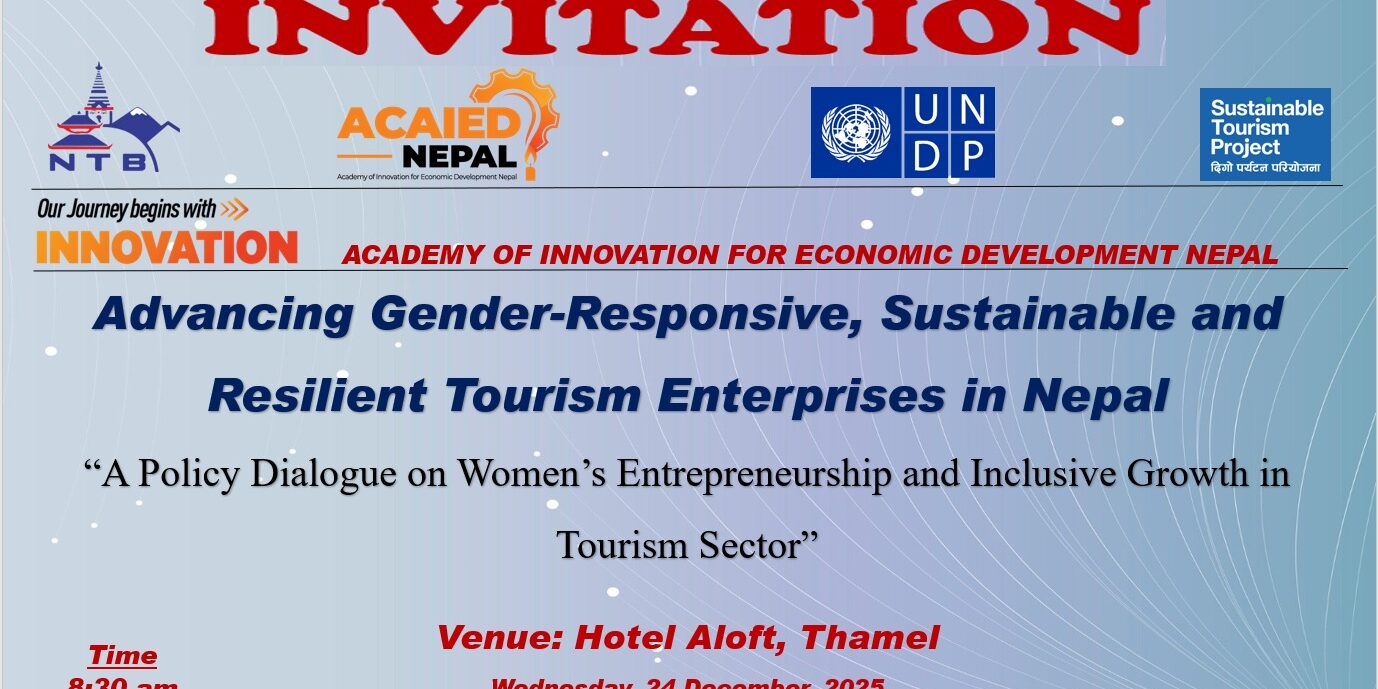
This one-day policy dialogue is designed to provide a structured platform for policymakers, development partners, private sector actors, women entrepreneurs, and experts to examine how gender-responsive approaches can strengthen the sustainability and resilience of tourism enterprises in Nepal. Organized by the Academy of Innovation for Economic Development (ACAIED) Nepal in collaboration with the Sustainable Tourism Project—a joint initiative of the Nepal Tourism Board (NTB) and the United Nations Development Programme (UNDP)—the workshop will align closely with donor priorities on women’s economic empowerment, inclusive growth, and sustainable tourism.
The dialogue will help bridge gaps between policy intent and practice, highlight successful models and lessons learned, and generate actionable insights to inform future programming and policy reform.
Objectives
Overall Objective
To contribute to policy-relevant dialogue on advancing gender-responsive, sustainable, and resilient tourism enterprises in Nepal, with a focus on women’s entrepreneurship and inclusive growth.
Specific Objectives
- To assess key challenges and opportunities faced by women-led tourism enterprises.
- To examine policy and programmatic measures that promote gender responsiveness and enterprise sustainability.
- To identify strategies for strengthening resilience against economic, climate, and market-related shocks.
- To generate practical policy insights and recommendations for government agencies, development partners, and the private sector.
Key Discussion Themes
Theme 1: Gender-Responsive Tourism Entrepreneurship and Enterprise Sustainability
This theme will explore how gender-responsive policies and business practices can enhance the long-term sustainability of women-led tourism enterprises.
Talking Points:
- Status and diversity of women’s participation in Nepal’s tourism enterprises.
- Gender-specific barriers related to finance, skills, technology, markets and networks.
- Role of gender-responsive policies, regulations, and institutional support mechanisms.
- Good practices and scalable models of women-led sustainable tourism enterprises.
- Contribution of women’s entrepreneurship to decent work, local value chains, and inclusive growth.
Theme 2: Building Resilience in Women-Led Tourism Enterprises
This theme will focus on how we can strengthen the capacity of women-led tourism enterprises to withstand and adapt to shocks.
Talking Points:
- Key vulnerabilities to economic downturns, climate change, disasters, and market disruptions.
- Enterprise-level strategies for risk management, diversification and innovation.
- Access to finance, insurance, digital tools and social protection as resilience enablers.
- Role of public–private partnerships and development programs in resilience building.
- Integrating resilience measures into tourism recovery plans and local development strategies.
Panel Discussion Sessions
Panel 1: Women’s Entrepreneurship in Tourism: From Policy Commitments to Practice
This panel will examine how existing policies and programs can be better aligned and effectively implemented to support women-led tourism enterprises.
Panel 2: Inclusive and Resilient Tourism Growth: Priorities for Collaboration and Action
This panel will synthesize key insights from the dialogue and identify priority actions and partnerships for advancing inclusive and resilient tourism growth.
Participants and Discussants
The workshop will convene approximately 30–40 participants, including:
- Government and Public Sector: Nepal Tourism Board; Ministry of Culture, Tourism and Civil Aviation; Ministry of Women, Children and Senior Citizens; selected local governments from tourism-prioritized areas.
- Development Partners: UNDP; Sustainable Tourism Project representatives; other partners working on gender equality, livelihoods, and tourism.
- Private Sector: Women-led tourism enterprises; hotel, travel, and homestay associations; chambers of commerce and tourism associations.
- Academia and Experts: Economists, gender specialists, tourism researchers, and policy analysts.
- Civil Society: NGOs and networks working on women’s economic empowerment and sustainable tourism.
Expected Outputs
The workshop is expected to deliver:
- A consolidated set of policy-relevant insights and recommendations on gender-responsive, sustainable, and resilient tourism enterprises.
- Improved shared understanding among stakeholders on constraints and opportunities facing women-led tourism businesses.
- Identification of priority action areas for policy reform, program design, and partnerships.
- Strengthened coordination and dialogue among government, development partners, and the private sector.
- A concise workshop summary note or policy brief to inform future initiatives and advocacy.
Duration & Venue
- Duration: One – day Policy Dialogue
- Venue: Aloft Hotel, Thamel, Kathmandu.
08:00 – 08: 45 – Registration & Welcome Tea
08: 45 – 09: 15 – Inaugural Session
Technical Session: 09:15 – 01:10
09: 15 – 09:55 – 1st Thematic Session Presentation
Theme 1: Gender-Responsive Tourism Entrepreneurship and Enterprise Sustainability
Talking Points:
- Status and diversity of women’s participation in Nepal’s tourism enterprises.
- Gender-specific barriers related to finance, skills, technology, markets and networks.
- Role of gender-responsive policies, regulations, and institutional support mechanisms.
- Good practices and scalable models of women-led sustainable tourism enterprises.
- Contribution of women’s entrepreneurship to decent work, local value chains, and inclusive growth.
09:55 –11: 05– 1st panel discussion
Women’s Entrepreneurship in Tourism: From Policy Commitments to Practice
This theme will explore how gender-responsive policies and business practices can enhance the long-term sustainability of women-led tourism enterprises.
11: 05 – 11: 20 – Refreshment Break
11: 20 – 12: 00 – 2nd Thematic Session Presentation
Theme 2: Building Resilience in Women-Led Tourism Enterprises
Talking Points:
- Key vulnerabilities to economic downturns, climate change, disasters, and market disruptions.
- Enterprise-level strategies for risk management, diversification and innovation.
- Access to finance, insurance, digital tools and social protection as resilience enablers.
- Role of public–private partnerships and development programs in resilience building.
- Integrating resilience measures into tourism recovery plans and local development strategies.
12 : 00 – 01: 10– 2nd panel discussion
Inclusive and Resilient Tourism Growth: Priorities for Collaboration and Action
This theme will focus on how we can strengthen the capacity of women-led tourism enterprises to withstand and adapt to shocks.
01: 10 – 01 :50 – Lunch and Networking


